
Three track habits I borrow for DB feet: wicket rhythm, fly-in timing, and curve-running hips that don't overreach.
Wicket rhythm for steps that stop lying
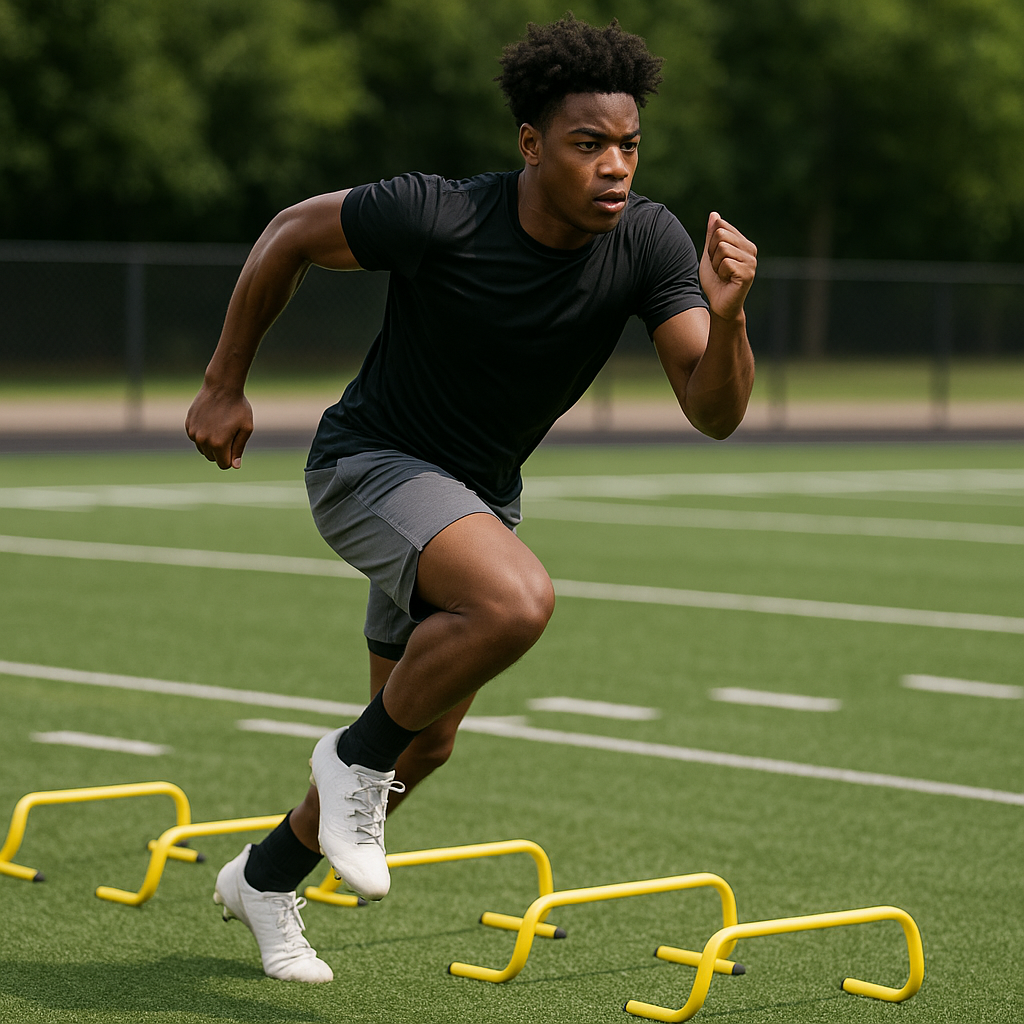
I started stealing this from our track coach because corners love to say they got beat on the ball, when the truth is their first six steps were a mess. Wickets clean that up fast because they punish sloppy stride without you having to yell about it. You don\'t need real hurdles. I\'ve used mini-hurdles, flat disc cones, even taped lines on the turf when we were short on gear. Set 8 to 10 markers in a straight line with about 4.5 to 5.5 feet between them (start tighter if your guys are short-striders, widen it if they\'re long and springy). The rule is simple: one foot in each gap, hips tall, eyes up, and the foot hits under the hip, not way out in front.
Here\'s the football part. I don\'t let a DB run it like a 60-meter sprinter. I want a controlled build that feels like the first phase of a bail technique: shoulders quiet, arms compact, no big reach. Two reps in, you\'ll see who\'s overstriding because they\'ll clip a marker with their heel and get that little stutter that looks exactly like getting stacked on a go. When that happens, I cue one thing: shorten the swing leg, speed up the turnover. It\'s amazing how often the kid\'s first fix is just not trying to cover ground like he\'s chasing the long jump pit.
Once they look clean, I finish with a football add-on that still feels like track: after the last wicket, give them 8 to 10 yards of free run, then a coach flashes a hand left or right and they have to drop their hips and take two hard angle steps (not a full break, just the first bite). If their feet were honest through the wickets, that two-step angle looks sharp. If they were cheating the spacing, they float and reach, and you can call it out on the spot.
The fly-in 20 that fixes late eyes
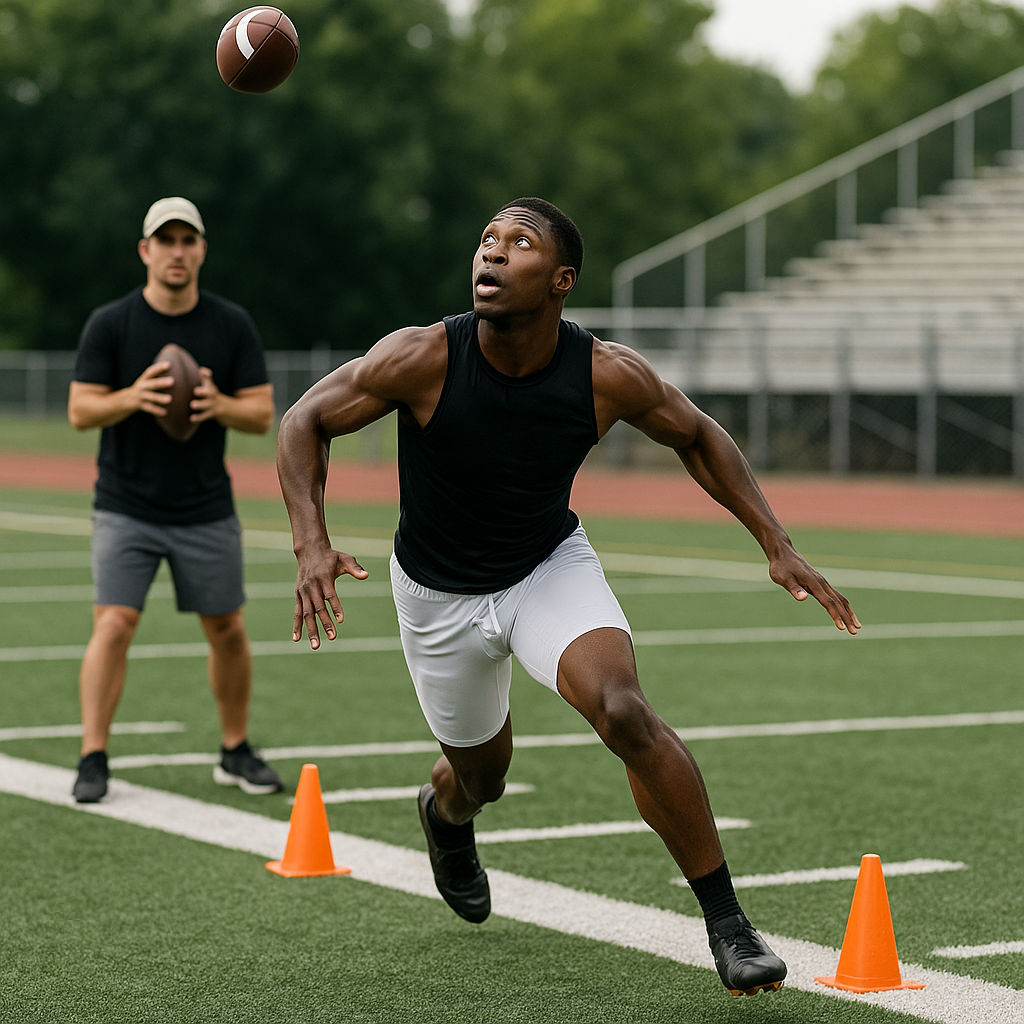
If you\'ve coached defensive backs for more than a week, you\'ve seen this: kid can run, kid can jump, but once he opens and runs with a receiver he either starts peeking early or he never looks at all. Both problems get worse when you test speed from a dead stop, because it bakes in tension. Track solves that with fly-ins, and it maps cleanly to coverage because most of our top-end running happens after we\'re already moving.
Set a 30-yard lane on the sideline. The first 10 is a smooth build, the next 20 is the timed zone. I use two cones for the start of the fly zone and two for the finish. You can time it with a phone app if you want, but you don\'t have to. The point is feel: by the time they hit the first pair of cones, they should be upright and rolling, not still clawing for acceleration.
Now make it a DB rep without turning it into a track meet. Put a coach or manager 12 to 15 yards off the lane, even with the start of the fly zone, holding a football at chest level. The DB is running down the lane, and the coach gives a late ball cue in the last 5 yards of the fly zone: raise the ball high (think fade), point down (think underthrown), or hold it still (no ball, stay on your line). The DB\'s job is to keep sprint mechanics clean and respond with only the head and eyes first. If the cue is high, I want a quick look and a \"find\" hand without the stride shortening into a hop. If it\'s down, I want him to throttle by dropping the hips over two steps, not slamming on the brakes like he\'s doing a suicide. That decel is the part track kids are sneaky good at, because they\'re used to finishing through a line instead of guessing.
What surprised me is who struggles. It\'s often your strongest room guys, the ones who try to muscle speed. They tighten their shoulders, their feet get loud, and when they turn their head it yanks the whole torso. After a few fly-ins, they learn a calmer sprint posture that keeps their hips under them. And once they trust that posture, their eyes get better because they\'re not fighting their own body just to run.
Curve running to stop the panic grab
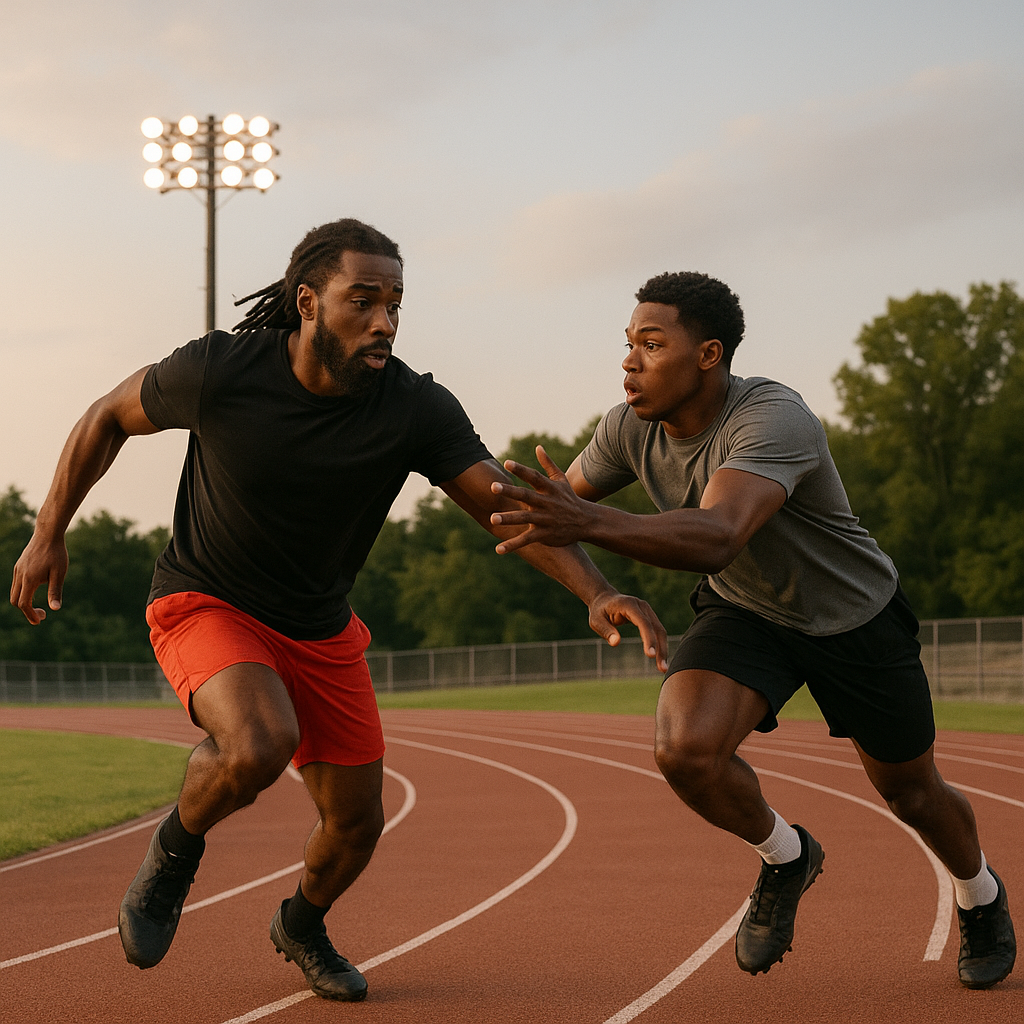
The track curve is the most underused DB teacher we have access to, and it\'s sitting right behind most schools\' stadium lights. Every time a receiver threatens you on an outside release, you\'re basically asked to run a curve without looking like you\'re running a curve. That\'s where the panic grab comes from. The DB feels himself getting pulled wide, his inside foot crosses over, his hips swing open, and his hand shoots out because he knows he\'s about to lose leverage.
Take them to lane 1 and use the 200-meter start line as your marker. I like groups of three. One kid runs the curve at about 85%, one shadows as the DB with inside leverage, and the third is a spotter who watches feet and calls out what he sees. The DB\'s rule: you\'re not allowed to cross your feet on the curve. Stay in a two-step rhythm that feels like you\'re stepping slightly under your center, with the inside foot landing a little flatter and quicker. I cue it as: inside foot is the steering wheel, outside foot is the gas. If the inside foot gets lazy and lands way out, the hips drift and you\'ll see that reach-and-grab impulse immediately.
After one rep, swap roles, but keep the same lane and the same starting point so you can compare. On a good rep, the DB looks boring. He stays hip-to-hip without drifting into the receiver\'s path, and his shoulders don\'t swing like he\'s fighting the turn. On a bad rep, it\'s loud: you\'ll hear the outside foot slap, then you\'ll see the inside leg sweep across like he\'s trying to catch himself. That\'s the exact moment he\'s holding on Friday night.
To tie it back to coverage, finish with a simple constraint: when they hit the middle of the turn, the receiver gives a subtle speed change, just one gear up or one gear down. No head fakes, no full route tree. The DB has to match the tempo change without losing the curve. Track kids do this all the time when they float the bend and then punch the straight. Your corners can learn it too, and it shows up fast in how clean they stay when the receiver tries to widen them before stacking.